
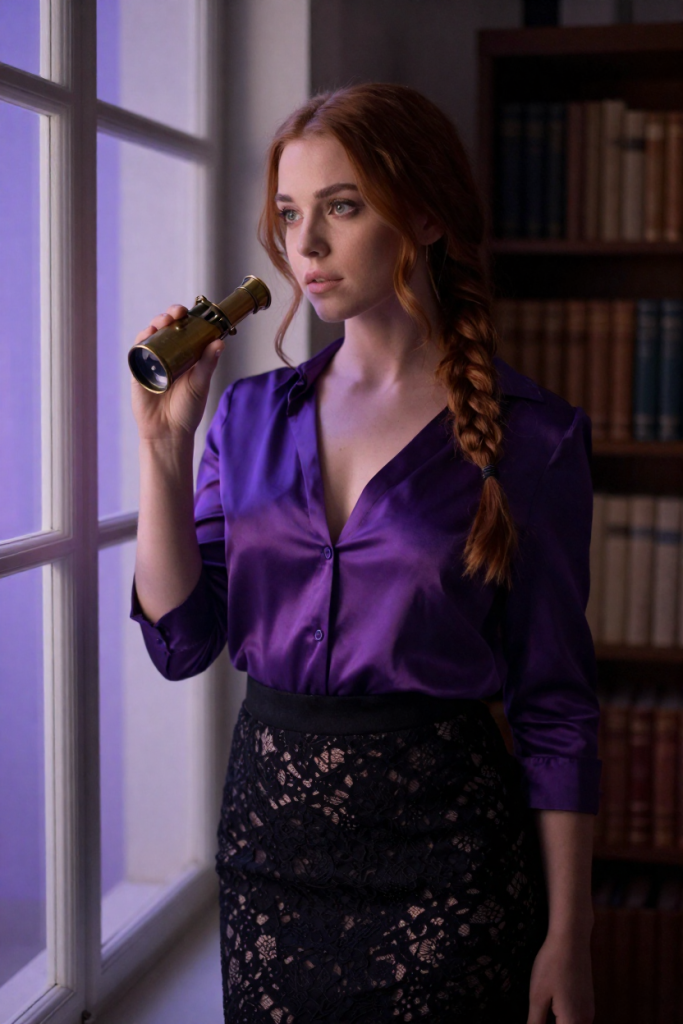
People imagine a spyglass is for seeing far. Practised hands know it is for seeing less: a narrow circle of the world, isolated from everything around it, suddenly available for real attention. Composition is the same instrument used in advance — and most weak frames are not badly drawn, they are badly fielded.
Choose the field before the subject performs
Decide what the frame contains before describing what she does in it: window and muse; desk, lamp and muse; nothing else admitted. A brief that begins with the field — “a tall study window, violet dusk, one woman” — gives the generator a stage with walls. A brief that begins with adjectives gives it a fog.
Exclusion is a positive act
The study keeps a short list of things its frames refuse: readable text, extra people, modern clutter, second light sources. Writing the refusals into your habits (and occasionally into the brief) does more for a portrait than any addition. What a frame excludes is what lets its subject be found.
Narrow first. The magnification — premium models, finishing passes — is for later, and for frames whose fields were chosen like a spyglass chooses: deliberately, and small.